Thursday, 4 August 2016

Blockchain: Understanding the fundamental technology that will change our lives


When I attended the Mobile World Congress (MWC) in Shanghai, I met several successful entrepreneurs who took advantage of disruptive technologies that have turned out to astounding business value. This made me curious about the fundamental technology that I heard many times - Blockchain. Imagine you can eliminate the middlemen without worrying about the trustworthiness of the other party in a business transaction. In my opinion, any new technology that can reduce costs and maximize business efficiency will stay.

The Byzantine Generals Problem

Blockchain was created by dealing with a type of problem called the Byzantine Generals Problem.

Byzantine Empire had a large territory. To protect its boundaries, several divisions of the Byzantine army had to camp outside an enemy city, each division commanded by its own general. The generals could communicate with one another only by messengers. After observing the enemy, they must decide upon a common plan of action. However, some of the generals might become traitors, trying to prevent the loyal generals from reaching an agreement. Therefore, the general must have an algorithm to guarantee that all loyal generals decide upon the same plan of action, and so a small number of traitors could not cause the loyal generals to adopt a bad plan.

Blockchain was created to deal with this type of problem: to build a reliable system able to cope with the failure of one or more of its components.

What is Blockchain


Blockchain can be viewed as an encrypted digital ledger that keeps a record of all transactions that take place across a peer-to-peer network. All information transferred via blockchain is encrypted, and every occurrence is recorded. This record cannot be altered. Moreover, all Blockchain use is decentralized, meaning there’s no need for any central certifying authority.

Source: Internet of Things World News #IoTSec16


The Main Characteristic of Blockchain - Decentralization


There are many ocean killers, i.e. great white sharks and killer whales. How do the weak sardines survive in the ocean?
Sardines have formed a group effect in the natural evolution. When facing a shark, they will gather together to form a group. The rule is simple: each sardine maintains the same distance and direction of the ones around it. When the predators attack them, the changes of the group will make the shark lose a single target and does not know who to capture. This group is indeed a decentralized system, which allows sardines to survive and constantly evolve in cruel nature.

One of the major characteristics of Blockchain is decentralization. In a system with many distributed nodes,  each node has a high degree of autonomy. Nodes can be freely connected to create a new connection unit at any time. Any one node can become the centre of a stage, but does not possess central control functions.

What does Blockchain Mean for the Internet of Things (IoT)


Christopher O’Connor, GM at IBM Internet of Things wrote a great article about this topic.

According to Chris, Blockchain is beginning to play a major part in the IoT by enhancing security, enabling inclusion of low-value devices to be increasingly viable and making managing a device easier for decades to come.

Source: Internet of Things World News #IoTSec16

Blockchain Use Case - IoT Security


IBM and Samsung formally unveiled ADEPT at CES 2015 in Las Vegas. The ADEPT concept, or Autonomous Decentralized Peer-to-Peer Telemetry, taps blockchains to provide the backbone of the system, utilizing a mix of proof-of-work and proof-of-stake to secure transactions.

IBM and Samsung envision networks of devices that are capable of autonomously maintaining themselves. For example, “using ADEPT, a Samsung W9000 washing machine can become a semi-autonomous device capable of managing its own consumables supply, performing self-service and maintenance, and even negotiating with other peer devices both in the home and outside to optimize its environment.”

Source: Internet of Things World News #IoTSec16


Blockchain Will Change Our Lives

We have seen that the Blockchain has been disrupting the financial industry such as Bitcoin. There is a great video about the real value of Bitcoin and crypto currency technology. Although there are some challenges of a decentralized blockchain, billions of connected smart things will need a ledger of everything.

Here are some examples of companies involved in the Blockchain and IoT businesses:

Slock is a Blockchain + IoT solutions company in Germany. Slock has worked with clients to build a fully decentralized, 100% free, and open source DAO (Decentralized Autonomous Organizations) framework - the future infrastructure of the service economy.

Visa has worked with Docusign to use Blockchain technology for car lease, rental and more. Each car is registered on the blockchain using a unique digital identity assigned to them. The cars digital identity is connected to Visa payment channel and to DocuSign platform. Whenever a customer wants to rent a car, he/she can enable the services by authenticating his preferences using his/her DocuSign electronic signature.

Source: "Blockchain: Reshape the economy and the world "

Special thanks to Mr. Xu, Mr. Liu, Mr. Duan, and Mr. Guo who generously shared their insights on this topic. I have no relationship with any of them, and no stake in sales of their book, or in promotion of companies mentioned in this article.

Monday, 13 June 2016

Marketing & technology marriage - My personal experience & thoughts

I have constantly been asked what’s the impact of disruptive technologies on marketers. This has been and will be an ongoing topic. Here are some of my experience and thoughts:


Source: Redpoint.net


Market research


I started my marketing career as a market research analyst. At that time, my roles included creating and designing survey questionnaires, interviewing people in-person or on the telephone to collect survey data, running various focus group meetings, and spending hours to analyze the results using SPSS. My boss and other decision makers usually had to wait for weeks/months for the expensive research reports, depending on the size of the survey. The results, unfortunately, might be biased because people would give false information as impacted by factors such as social proof while answering survey questions.


Social listening


The wide use of social media is a good supplement for surveys and allows decision makers to receive real-time unfiltered information directly on how customers are thinking towards the products, customer services, as well as those from the competitors.


Search trends


Cassandra Clare said that “You will know what kind of man he is not by the things he says, but by the things he does.”


In Marketing, I see more and more companies rely more on search data to understand what people really think in order to strategize better and realign marketing tactics. Google Trends is one of the tools to help marketers discover the hottest topics in a given region and time period.


Virtual Reality

Compared to surveys and panels, virtual reality gives marketers more valuable and accurate insights into customers’ thoughts about products like colour schemes and packaging.

Besides market research, virtual reality will be widely used in other aspects of marketing such as content marketing.


For example, Unicef ran a virtual reality fundraising campaign to allow people to be put in the shoes of a 12-year-old girl and experience the real situation in a refugee crisis, rather than reading a story or seeing pictures. As a result, 1 in 6 people donated, twice the normal rate.

Account-Based Marketing

Account-Based marketing has been a proven effective strategy. It is the application of the Pareto principle in Marketing -  20% of customers generate 80% of businesses. Instead of targeting a mass market, account-based marketing identifies the Ideal Customer Profile (ICP) by using marketing technology and data analytics tools. Then we engage with customers via their desired channels, whether it’s email, social media, events or webinars, etc. Once the best practice is in place, we learn from the results and start the process again to identify other potential customers/partners.

Source: MarketingProfs.com

To sum up, the impact of technology on marketing has been and will be immense. However, the major principles of marketing are timeless. Each company faces unique challenges and opportunities and therefore has its own way to make the marriage of marketing and technology successful.  


Sunday, 17 April 2016

How companies used psychology to make compelling and successful marketing campaigns


What keeps every marketer awake at night is how to take a marketing campaign from good to amazing. Knowing some key principles of psychology is important because the essence of marketing is to understand customers’ needs and wants. In the Psychology for digital behaviour change workshop 2016, Brian Cugelman shared his research on how companies use psychology to make compelling marketing campaigns.

Photo credit: AlterSpark Corp. Canada

Curiosity and Reward

Curiosity and anticipation of reward is one of the critical levers that marketers to motivate customers. The following 30-minute video is one great example. The video featuring unwrapping surprise eggs generated 40 million+ views on YouTube.

Photo credit: Disneyland

Self-Efficacy

Psychologist Albert Bandura has defined self-efficacy as one's belief in one's ability to succeed in specific situations or accomplish a task. Helping potential customers to develop a sense of self-efficacy is the important motivation behind their decisions.

Home Depot created its YouTube channel and has provided various guides for home improvement products and DIY projects from to-do to done.

Social Proof

Social proof, simply put, means people tend to follow the crowd.

Photo credit: Kraft Foods

Kraft used social proof and run a phenomenal marketing campaign themed “it’s changed, but it hasn’t.” Justin Bariso, founder Insight, wrote an article about how Kraft used psychology to make its mac and cheese go viral.

Persuasion

Persuasion applies only when we understand what our customers truly need and want.

John Boykin used selling cat food as an example and pointed out three mistakes we need to avoid if we don’t work directly with the end user in his video:

  1. Put the owner first
  2. To imagine the cat are like “us” - the cat food manufacturers
  3. The owner can compel cat to do what he/she wants


Trust

Trust is one of the major objectives that companies want to build with their customers.

We are talking about the sharing economy quite often these days. People share content for emotional reasons, most likely, not for economic reasons. However, many marketing campaigns are created for direct selling purposes. This is one of the reasons why we see expensive marketing campaigns like paid search, display ads and print ads suffer from proving real ROIs, although they may generate traffic and viral effects.

When we are busy dealing with numerous emerging marketing technologies, it’s worth reviewing those important principles of psychology that will help marketers attract, convince, and convert more prospective customers with our marketing campaigns.


Thursday, 10 March 2016

How can marketers harness micro-moments to win the mobile battlegrounds


Another great opportunity provided by Powered by Search to attend Google partners meeting at Google Canada’s headquarter.

Source: Google partners meeting, Toronto

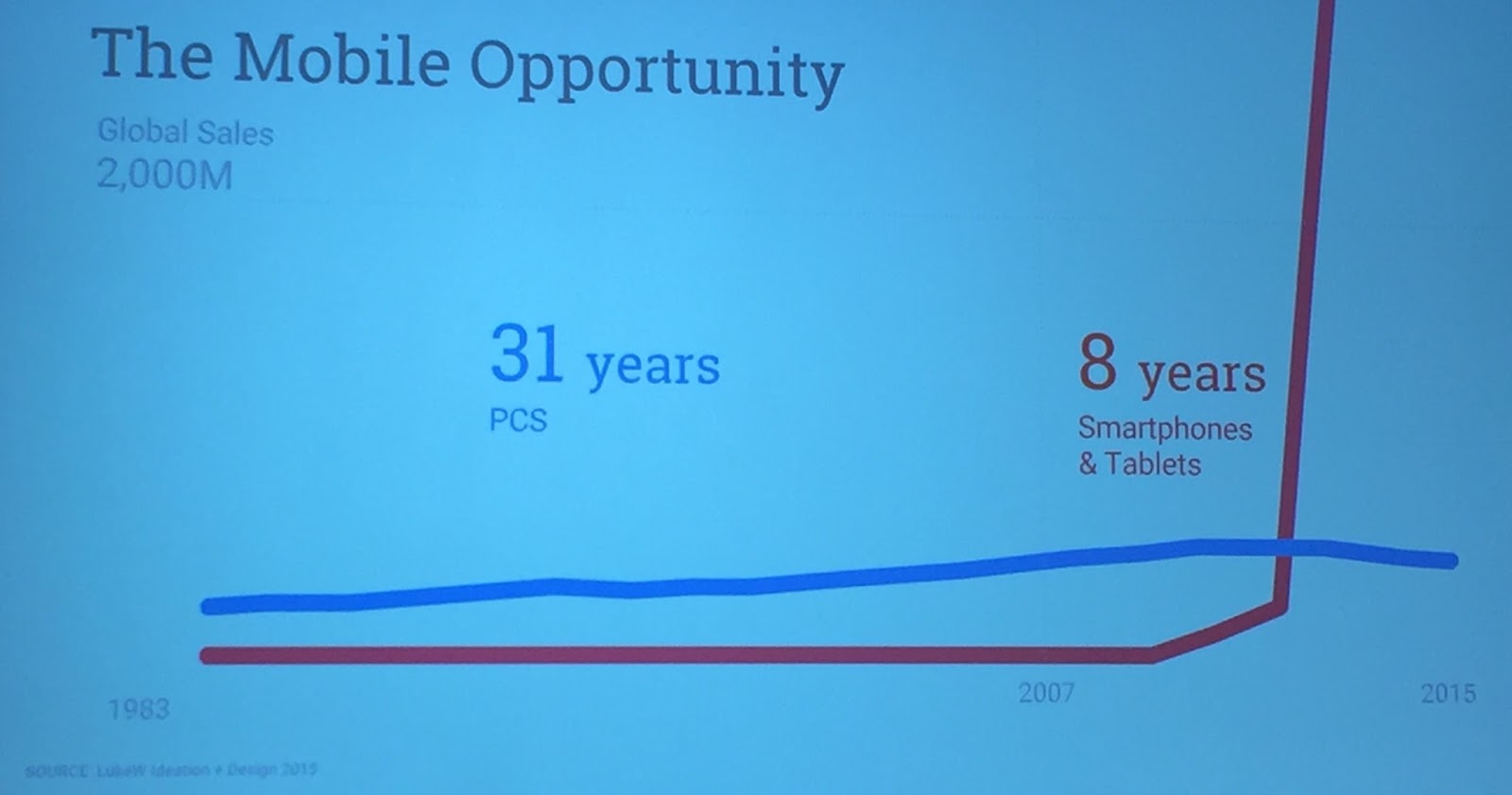
Google started the session with an astounding fact that mobile phones and tablets surpassed desktops in 8 years with 2,000 million global sales in 2015.

Source: Google partners meeting, Toronto

How Mobile Impact Brands

Mobile Search

I noticed that when I asked my team to check our new website last year, most of them checked on their mobile phones.

This year, 80-90 percent of Super Bowl related searches across Google and YouTube were done on mobile phones.

Soon, mobile will represent 50% of the world’s online traffic. No company can afford to miss this mobile trend. However, it is crucial to understand how to act and benefit in a mobile world.

Micro Moments

Mobile has changed the way consumer behaves and has fractured the consumer journey into hundreds of real-time, intent-driven micro moments.

What are micro moments? As Google explained that we live not in years, months, even hours, but in moments. We all try to make the most in every moment. The following graph gives an example of micro moments:

Source: Google partners meeting, Toronto

New Battlegrounds for Brands

As the following graph illustrates that micro moments mean the new battlegrounds for brands:

  • Reduced time spent per visit
  • Increased use of mobile search
  • Mobile conversion rates growth

Source: Google partners meeting, Toronto

How Can Marketers Succeed at Micro-moment Marketing?

Identify Your Consumer’s Micro Moments

Companies can utilize a free tool - Google trends to identify what consumers search at different time periods in different regions and develop the marketing opportunity accordingly.

Spin Master identified that consumers searched its toys like Zoomer Dino right before Christmas for last-minute shopping and designed targeted ads to meet these shoppers’ needs resulted in a significant increase in sales.

Content and Intent

Needless to say how important companies have to understand consumers’ needs with data.
In a situation that we need to learn, do, find or buy something right now, many of us pick up our mobile phone. The micro-moments happen constantly whether in the form of searches, app interactions, mobile site visits or video views. Therefore, as it’s said that “Being present is half the battle.”

Sephora, a beauty retailer applied a data-drive approach for its mobile strategy. They found out that consumers tend to use their mobile phones to search for product reviews or remember what was the product they bought last time before they buy a product.

Sephora utilized Google’s local inventory ads and its app to help consumers make a decision while they are in a beauty store and provides high quality of customer experiences.

Consumers are loyal to their needs not brands nowadays. Companies who can meet and even exceed consumer’s requirements will outperform other brands.

Measurement

As management thinker Peter Drucker said if you can’t measure it, you can’t improve it. Google provided a list of sample metrics to measure marketing campaign effectiveness as illustrated in the following picture.

Source: Google partners meeting, Toronto

These metrics are all important. However, what matters most is how marketing campaigns can increase sales and revenue, especially for entrepreneurial businesses.